
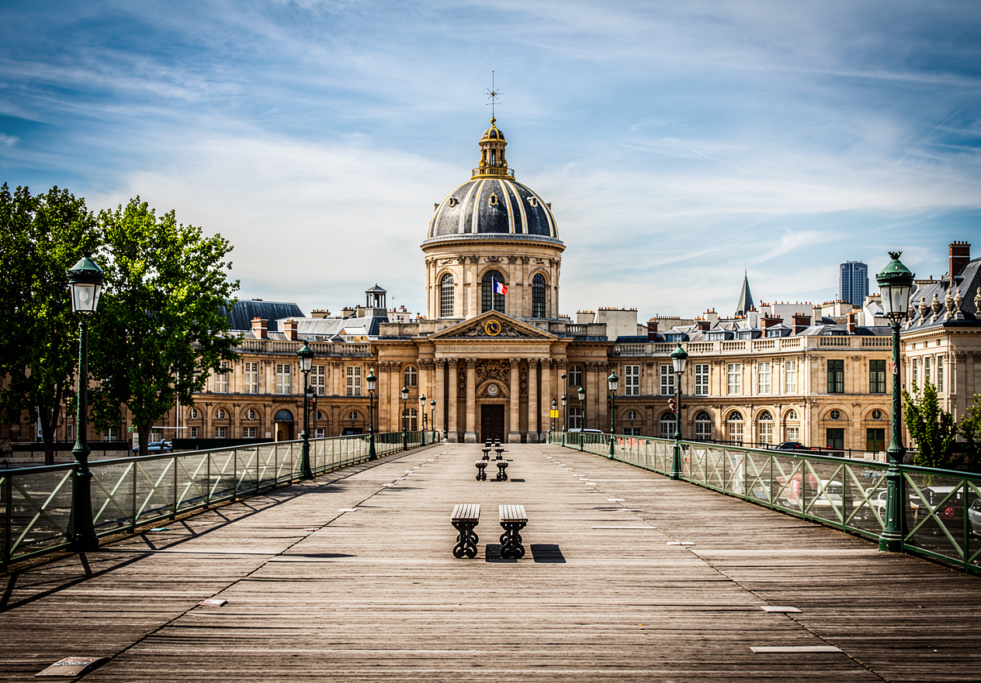
Saint-Germain-des-Prés sits in the 6th arrondissement on the Left Bank of the Seine. The neighbourhood was shaped by the post-war years — cafés, jazz and the Existentialist circle — and still mixes a medieval abbey, galleries, bookshops and fashion stores. It is expensive and busy, but useful if you want classic café culture, the Delacroix museum and streets made for walking. For lunch or dinner, Le Comptoir du Relais is a bistronomie reference on the Carrefour de l'Odéon; for artisan bread, Poilâne on Rue Cherche-Midi is essential.
The abbey and the neighbourhood's origins
In 543, Merovingian king Childebert I ordered a basilica for relics of Saint Vincent and the True Cross. Consecrated in 558 by Bishop Germain of Paris, it became the burial place of Merovingian kings — hence Saint-Germain-des-Prés ("of the meadows").
In the Middle Ages, the abbey was one of France's richest religious institutions, with an important scriptorium and library. Raided by Vikings in the 9th and 10th centuries, it was rebuilt in Romanesque style — the bell tower is Paris's oldest.
After the Revolution, the abbey was suppressed; the library burned and the building became a gunpowder factory (an 1794 explosion destroyed the cloister). In the 19th century, artists like Delacroix, Balzac and George Sand settled on the Left Bank.
Existentialism, jazz and the post-war years
In the 1940s, Saint-Germain became headquarters of Existentialism. Jean-Paul Sartre and Simone de Beauvoir wrote in local cafés; Albert Camus, Boris Vian, Jacques Prévert and Juliette Gréco frequented the same places.
At the same time, American jazz — brought by Allied soldiers — found a home in the caves jazz clubs, like Le Tabou. The energy cemented the neighbourhood as a reference for intellectual freedom — though today the historic cafés' prices reflect tourism more than bohemia.
What to see
Church of Saint-Germain-des-Prés: Paris's oldest surviving religious building. Romanesque architecture (11th century) and early Gothic choir (12th century). 19th-century mural paintings by Hippolyte Flandrin. Tomb of René Descartes in a side chapel (the skull is at the Musée de l'Homme).
Café de Flore and Les Deux Magots: side by side on Boulevard Saint-Germain. Sartre and Beauvoir adopted the Flore as their "office" — the owner kept a coal stove burning in winter. Hemingway, Picasso and Joyce frequented Les Deux Magots. Prices are high today (espresso ~€5.50), but sitting on the terrace remains a Parisian ritual.
Church of Saint-Sulpice: Paris's second-largest church. Delacroix's monumental frescoes in the Chapel of Angels (Jacob Wrestling with the Angel). 1862 Cavaillé-Coll organ. The astronomical gnomon on the floor — a brass line marking solar noon — gained fame through The Da Vinci Code, but its original function was calculating the spring equinox for Easter.
Musée Delacroix (Place de Furstenberg): apartment and studio where the painter lived from 1857 to 1863. Paintings, sketches, correspondence and a back garden. Entry €9.
Le Bon Marché and La Grande Épicerie: the world's first modern department store (1838, revolutionised in 1852). Iron and glass architecture with engineering from Gustave Eiffel's firm. La Grande Épicerie next door stocks cheeses, wines and imported gourmet products.
Practical information
| Item | Practical Information (2026) |
|---|---|
| Address | Saint-Germain-des-Prés, 6th arrondissement, 75006 Paris. |
| How to Get There (Metro) | Main stations: Saint-Germain-des-Prés (Line 4), Mabillon (Line 10) and Saint-Sulpice (Line 4). |
| Opening Hours | Neighbourhood open 24 hours. Church of Saint-Germain: daily, 8am to 7:45pm. Historic cafés (Flore and Deux Magots): daily, 7:30am to 1:30am. Musée Delacroix: Wednesday to Monday, 9:30am to 5:30pm. |
| Ticket Price | Free access to the neighbourhood and churches of Saint-Germain and Saint-Sulpice. Musée Delacroix: €9.00 (free for under-18s and EU residents up to 25). Café prices: espresso around €5.50. |
| Official Website | musee-delacroix.fr | lebonmarche.com |
Practical tips
Historic cafés without queues: arrive at 8 or 8:30am for petit déjeuner. Before 10am, terraces are quiet and service is more attentive.
Citypharma: pharmacy at the corner of Rue du Four and Rue de Boniface — low prices on French dermocosmetics (La Roche-Posay, Caudalie, Vichy). Go at opening (8:30am) or mid-afternoon to avoid queues.
One-day route: morning at Saint-Germain church, Place de Furstenberg and Musée Delacroix; Saint-Sulpice; lunch on Rue de Buci; afternoon at Jardin du Luxembourg or Le Bon Marché. Cross the Seine to the Musée de l'Orangerie (15 minutes on foot along the river).
Frequently asked questions
1. Where is René Descartes buried?
In the Church of Saint-Germain-des-Prés, Saint Benoît chapel, right side of the choir. The skull is displayed at the Musée de l'Homme in the Palais de Chaillot.
2. What is the Saint-Sulpice gnomon?
An astronomical instrument from 1743: marble obelisk and brass line on the floor. Sunlight projects a circle crossing the line at solar noon, allowing calculation of the spring equinox. No connection to secret rituals — scientific and religious function.
3. Do Café de Flore and Les Deux Magots close in August?
No. They stay open 365 days a year, 7:30am to 1:30am — unlike many smaller establishments that close for summer holidays.
Combine with guides on this site
To keep exploring on this site, these guides pair well with this article: Le Comptoir du Relais, Poilâne and Musée de l'Orangerie.
Editorial note: prices, opening hours and booking conditions in this guide are references checked against official and institutional sources in July 2026. Confirm on the official website before your visit, as details may change.