
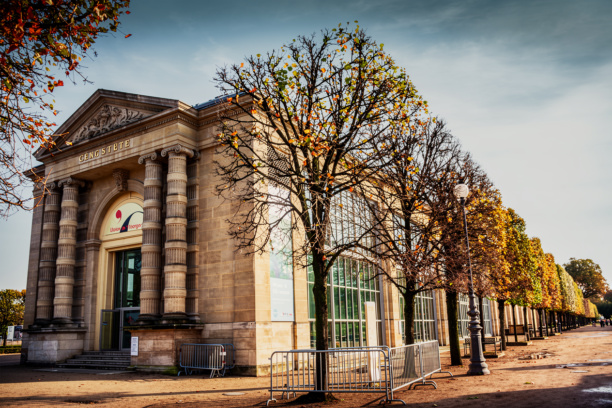
The Musée de l'Orangerie sits in the Jardin des Tuileries, at the west end near Place de la Concorde. It is a small museum — allow 1.5 to 2 hours — and the main reason to visit is Claude Monet's Nymphéas (Water Lilies): eight panels in two oval rooms designed for the cycle. If the Louvre feels too long for one day, the Orangerie works well as a focused stop. It is a 15-minute walk from Saint-Germain-des-Prés and pairs with lunch at Le Comptoir du Relais on the Carrefour de l'Odéon.
From royal greenhouse to museum
Built in 1852 by Firmin Bourgeois and Ludovico Visconti, the pavilion served as an orangerie — a greenhouse sheltering the Tuileries Palace citrus trees in winter. The south facade faces the garden with large windows for light; the north facade on Rue de Rivoli is more sober, aligned with Haussmannian architecture.
After the Tuileries Palace fire in 1871, the building lost its royal function and hosted temporary exhibitions and public events. Only after the First World War was the pavilion assigned to the fine arts administration to receive Monet's donation — turning the space into one of Paris's key Impressionist destinations.
Monet and Clemenceau
The day after the 1918 Armistice, Monet wrote to Georges Clemenceau — Prime Minister and personal friend — offering the French State two large decorative compositions painted at Giverny. Monet saw the gift as a monument to peace.
Clemenceau accepted but insisted on the full water-garden cycle, not just two canvases. He convinced Monet to design a permanent installation in the former Orangerie pavilion. The painter worked until his death in December 1926, despite advanced cataracts. The museum opened in May 1927, a few months later.
What to see
The Nymphéas rooms (upper floor): two linked elliptical rooms with soft zenithal light — exactly as Monet requested. Eight panels, 2 m high and up to 17 m long, cover nearly 100 linear metres of wall. Monet removed the horizon: no firm land, no direct sky; the visitor is immersed in water, reflected clouds and water lilies.
The cycle follows the passage of light through the day, oriented east to west. The first room holds Soleil Couchant, Matin, Les Nuages and Reflets Verts; the second, the willow panels and the twilight trio (Le Trio). Central benches invite contemplation — up close the brushstrokes look abstract; from a distance they create depth.
Walter-Guillaume collection (basement): around 150 works by Cézanne, Renoir, Picasso, Matisse, Modigliani, Soutine, Rousseau, Derain and Utrillo. Paul Guillaume was a decisive art dealer in the early 20th century; his widow Domenica, later married to Jean Walter, consolidated the collection acquired by the State in the 1960s. Allow 45 minutes for the basement.
Practical information
| Item | Practical Information (2026) |
|---|---|
| Address | Jardin des Tuileries, Place de la Concorde (Seine Bank), 75001 Paris. |
| How to Get There (Metro) | Station Concorde (Lines 1, 8 and 12). Follow signs to the Jardin des Tuileries exit. |
| Opening Hours | Wednesday to Monday, 9am to 6pm (last entry 5:15pm). Closed Tuesdays, 1 May and 25 December. |
| Ticket Price | €12.50 (full fare). Audio guide in Portuguese available for €5.00. Free entry for under-18s, EU residents aged 18–25, and all visitors on the first Sunday of each month (online timed booking essential). |
| Official Website | musee-orangerie.fr |
Practical tips
Timed booking: in 2026, all visitors — including Paris Museum Pass holders and free-entry visitors — must book a day and time slot on the official website. Without a reservation, entry may be refused.
Quietest times: book the first slot (9am) or late afternoon (from 4:30pm). Between 11am and 3pm, school and tour groups fill Monet's rooms.
Combined route: after your visit, walk through the Jardin des Tuileries, cross the Leopold-Sédar-Senghor footbridge and reach the Musée d'Orsay (10 minutes on the opposite bank). To stay nearby, Hôtel Henri IV is a few minutes from the Seine, with rooms facing the Louvre.
Frequently asked questions
1. Can I take photos inside the museum?
Yes, for personal use, without flash or tripod — in both Monet's rooms and the basement. In the Nymphéas rooms, keep noise down and respect other visitors' silence.
2. What is the difference between the Musée d'Orsay and the Musée de l'Orangerie?
The d'Orsay is large and covers Western art from 1848 to 1914. The Orangerie is small and focused: rooms built for Monet plus a select Walter-Guillaume modern collection. Visiting both gives a complete Impressionist and Post-Impressionist overview.
3. Is the audio guide worth renting?
Yes. It details each Monet panel and contextualises the basement collection — worth the €5 if you want more than a quick look.
Combine with guides on this site
To keep exploring on this site, these guides pair well with this article: Saint-Germain-des-Prés, Le Comptoir du Relais and Hôtel Henri IV.
Editorial note: prices, opening hours and booking conditions in this guide are references checked against official and institutional sources in July 2026. Confirm on the official website before your visit, as details may change.