
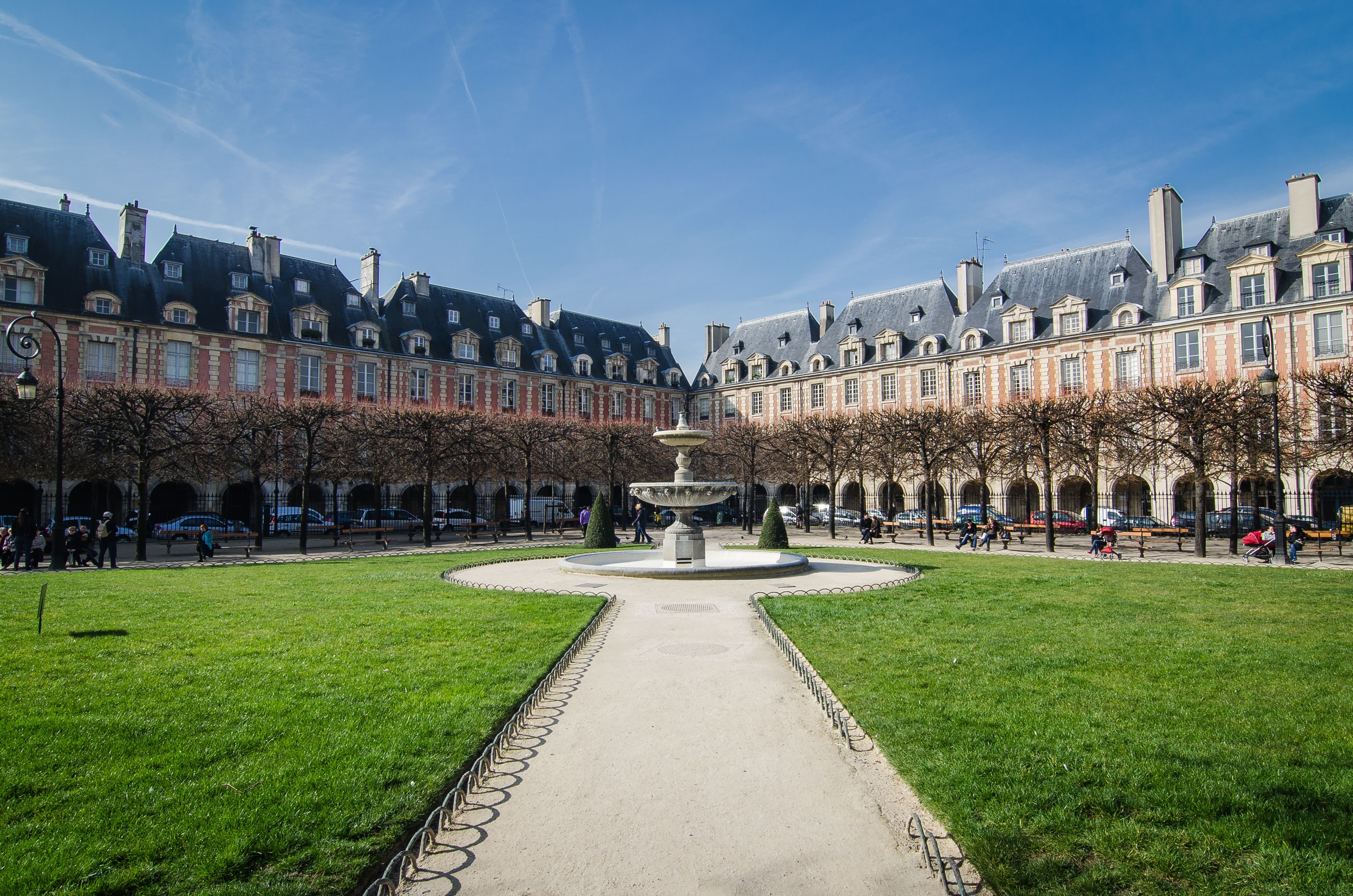
Le Marais covers parts of the 3rd and 4th arrondissements on the Right Bank of the Seine. The layout is still narrow lanes, 17th-century townhouses and inner courtyards — less Haussmann boulevard, more walkable neighbourhood. Today it concentrates museums (Picasso, Carnavalet), Place des Vosges, Rue des Rosiers and independent shops. For lunch, the Marché des Enfants Rouges works well; for fine dining nearby, L'Ambroisie on Place des Vosges is the reference (3 Michelin stars).
From medieval swamp to noble quarter
The name Marais means swamp. In the Middle Ages the area was flooded and considered unhealthy. Religious orders — the Knights Templar and monks of Saint-Martin-des-Champs — drained the land in the 12th century and turned it into market gardens supplying Paris.
In 1605, Henry IV ordered the Place Royale (today Place des Vosges), with symmetrical red-brick architecture and arcades. The neighbourhood became the nobility's address: architects like François Mansart designed hôtels particuliers with a courtyard of honour at the front and a garden at the back.
The 1789 Revolution ended the aristocratic era. In the 19th century, mansions became workshops and workers' housing — which, ironically, saved the Marais: Haussmann demolished whole districts, but ignored this dense industrial area, preserving the medieval layout.
In the late 19th century, Ashkenazi Jewish immigrants settled on Rue des Rosiers (Pletzl, Yiddish for "little square"). The community revitalised commerce but suffered deportations in the Second World War. In the 1960s, demolition plans threatened the neighbourhood until André Malraux created France's first secteur sauvegardé in 1962 — legal protection that launched the restoration we see today.
What to see
Place des Vosges: Paris's oldest planned square (1605), with 36 red-brick pavilions and slate roofs. At No. 6 is the Maison de Victor Hugo — the apartment where the writer lived from 1832 to 1848, now a free museum with manuscripts and furniture from the Les Misérables period.
Musée Picasso (Hôtel Salé): the world's largest Picasso collection — over 5,000 works covering Blue, Rose, Cubist and Surrealist periods. The 17th-century baroque mansion contrasts with avant-garde art.
Musée Carnavalet: the municipal museum of Paris history, reopened after a five-year renovation. Two adjacent mansions; free entry to the permanent collection. Highlights: Marcel Proust's reconstructed bedroom and Marie Antoinette's belongings.
Rue des Rosiers and the Pletzl: historic synagogues, challah bakeries (like Sacha Finkelsztajn) and permanent queues at L'As du Fallafel — Paris's most famous falafel, with grilled aubergine and tahini.
Shopping and fashion: independent boutiques on Rue de Vieille du Temple, Rue des Francs-Bourgeois and Rue de Charonne. Many mansion courtyards now house libraries and archives — the Hôtel de Soubise (National Archives) and Hôtel de Sully, with a secret passage to Place des Vosges, are worth the free entry.
Practical information
| Item | Practical Information (2026) |
|---|---|
| Address | Le Marais, encompassing the 3rd (Temple) and 4th (Hôtel de Ville) arrondissements, 75003 and 75004 Paris. |
| How to Get There (Metro) | Main stations: Saint-Paul (Line 1), Chemin Vert (Line 8), Hôtel de Ville (Lines 1 and 11) and Rambuteau (Line 11). |
| Opening Hours | Public neighbourhood open 24 hours. Boutiques generally open Tuesday to Sunday, 10am to 7pm. Museums such as Picasso close on Mondays; Carnavalet closes on Mondays. |
| Ticket Price | Free neighbourhood access. Musée Carnavalet and Maison de Victor Hugo: free entry to permanent collections. Musée Picasso: €14.00 (full fare; online booking recommended). |
| Official Website | museepicassoparis.fr | carnavalet.paris.fr |
Practical tips
Sundays in Paris: most Paris shops close on Sundays — but the Marais has special authorisation as a tourist zone. Boutiques, cafés and markets stay open and the neighbourhood buzzes. For less crowding, try a Tuesday or Wednesday morning.
Secret courtyards: many mansions house public institutions with free-access courtyards. Don't miss the Hôtel de Soubise and Hôtel de Sully.
One-day route: morning at Place des Vosges and Carnavalet; lunch at Marché des Enfants Rouges or falafel on Rue des Rosiers; afternoon at Musée Picasso or Centre Pompidou (western edge). For classic Parisian lodging, the Ritz Paris is 10 minutes by metro from Place Vendôme.
Frequently asked questions
1. Is the Marais safe at night?
Yes — one of Paris's most welcoming neighbourhoods, with active nightlife (restaurants, LGBTQ+ bars, galleries). Take basic precautions against pickpockets in crowded spots.
2. Why are some street signs in French and Hebrew?
In the Pletzl, bilingual signs honour the Jewish community that shaped the neighbourhood since the 19th century. An official City Hall initiative.
3. Is Marché des Enfants Rouges worth visiting?
Yes. Founded in 1615, it is Paris's oldest covered market. Moroccan, Japanese, Italian and French food stalls — more affordable than traditional restaurants nearby.
Combine with guides on this site
To keep exploring on this site, these guides pair well with this article: L'Ambroisie, Marché des Enfants Rouges and Ritz Paris.
Editorial note: prices, opening hours and booking conditions in this guide are references checked against official and institutional sources in July 2026. Confirm on the official website before your visit, as details may change.