
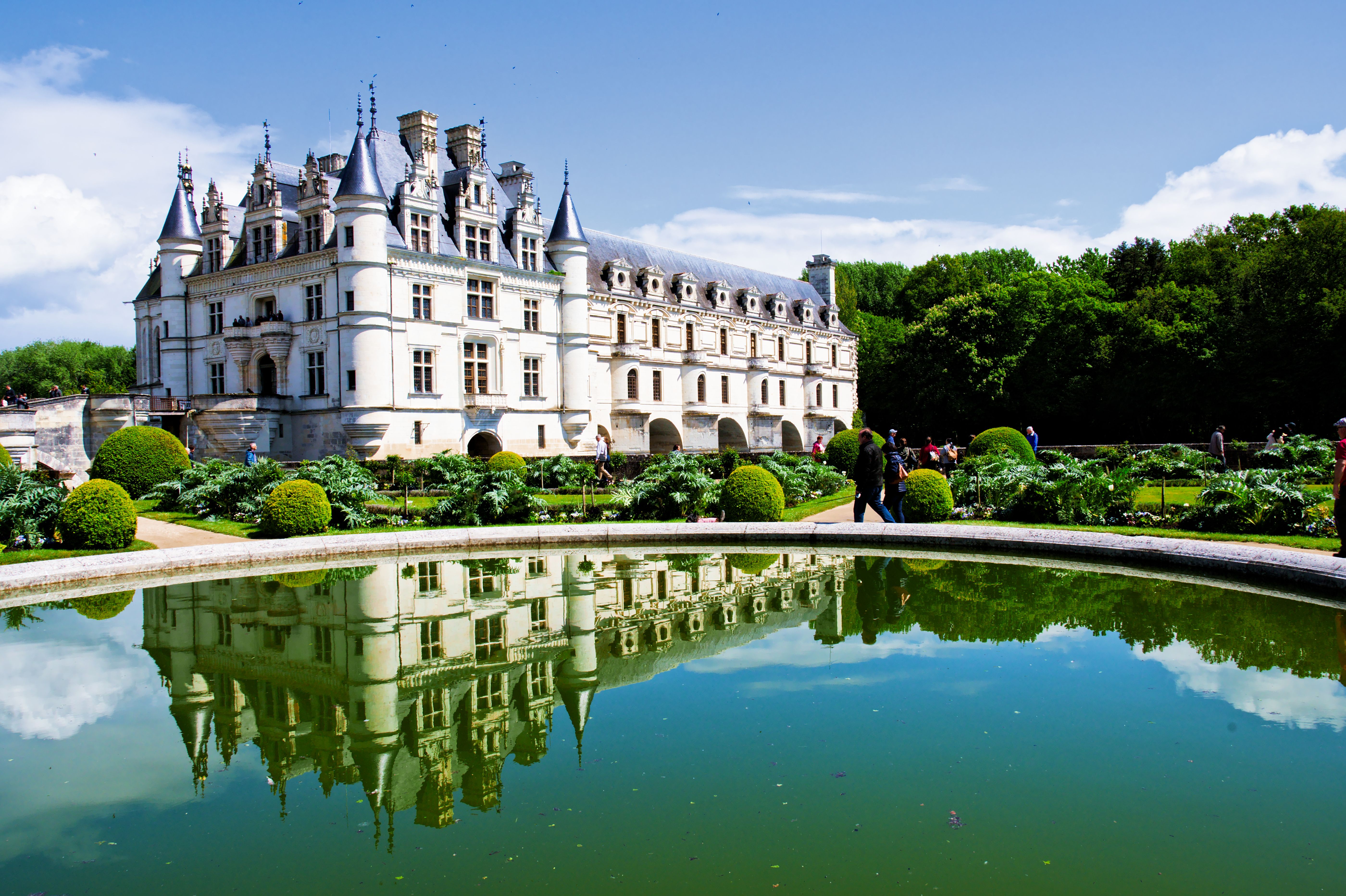
The Château de Chenonceau — the Château des Dames — spans the River Cher at Chenonceaux. The two-storey gallery on stone arches appears in almost every photo of the Loire Valley. Unlike Chambord or Villandry, Chenonceau was built, decorated and preserved mainly by women over five centuries: Katherine Briçonnet, Diane de Poitiers, Catherine de Medici, Louise de Lorraine and Louise Dupin, among others. It is the region's most visited château; arriving early (9am) reduces queues. Pairs with Villandry (30 min by car) and a stay at Closerie Belle Vue in Amboise.
The ladies of the Cher
Today's building began in 1513 when Katherine Briçonnet supervised demolition of the medieval fortress (keeping the Tour Marques) and erected a bright palace with a central straight staircase.
Henry II gave Chenonceau to Diane de Poitiers, who had a stone bridge built over the Cher and created the garden on the east bank. When Henry II died in 1559, Catherine de Medici forced Diane to swap Chenonceau for Chaumont-sur-Loire and built the 60 m Grand Gallery over the bridge.
Louise Dupin saved the château during the Revolution by arguing the bridge was the region's only trade route. In the First World War the Grand Gallery became a military hospital (2,250 wounded). In the Second, the Cher was the demarcation line; the gallery exit opened to the free zone, used to smuggle refugees.
What to see
Grand Gallery: 60 m long, black slate and white limestone floor, 18 windows over the Cher. Renaissance ballroom, 1914 hospital and Resistance escape route in the same space.
Kitchens in the pillars: on lower floors, inside the bridge's hollow pillars — polished copper, bakery, butcher's and boat landing platform.
Ladies' apartments: rooms with Renaissance furniture and paintings by Rubens, Tintoretto and Murillo. Highlights: Diane de Poitiers' room, Catherine de Medici's room and Louise de Lorraine's Black Room.
Gardens: Diane de Poitiers' (east bank, 12,000 m²) and Catherine de Medici's (west bank, 5,500 m²). Permanent floral workshop — fresh arrangements weekly in each room.
Practical information
| Item | Practical Information (2026) |
|---|---|
| Address | Château de Chenonceau, 37150 Chenonceaux, France. |
| How to Get There (Access) | By train: TER from Tours or Saint-Pierre-des-Corps to Chenonceaux (25 min). Station 400 m from the entrance. By car: A10 (Amboise exit), follow signs to Chenonceaux. Free parking. |
| Opening Hours | Open every day. High season (May–September): 9am–7pm. Mid season (April and October): 9am–6pm. Low season (November–March): 9:30am–5pm. |
| Ticket Price | €17.00 (château and gardens). With audioguide: €21.50. Children 7–18: €14.00. Free under 7. |
| Official Ticket Website | chenonceau.com |
Practical tips
Book online: May–September, reserve date and time on the website — including with tourist passes.
Boat under the arches: June–September, rowboat hire on the Catherine de Medici garden bank.
Quiet times: avoid Sundays in July. Monday–Thursday, 9am or after 4:30pm.
Visit duration: allow 3 hours — interior (~1h30), gardens, vegetable plot and box maze. L'Orangerie restaurant on the estate; crêperie and picnic at the entrance.
Frequently asked questions
1. Is advance booking mandatory?
Highly recommended in high season. Pass holders also need to book a time slot online.
2. Is there a restaurant at the château?
Yes. L'Orangerie serves French cuisine with garden views; self-service and crêperie at the entrance; free picnic near the car park.
3. How long does a full visit take?
Minimum 3 hours: interior, gardens, vegetable plot and Cher banks. With audioguide, add 30–45 minutes.
Combine with guides on this site
To keep exploring on this site, these guides pair well with this article: Villandry, Château de Chambord and Closerie Belle Vue.
Editorial note: prices, opening hours and booking conditions in this guide are references checked against official and institutional sources in July 2026. Confirm on the official website before your visit, as details may change.